 Cleanzine: your weekly cleaning and hygiene industry newsletter 5th November 2026 Issue no. 1233
Your industry news - first
The original and best - for over 20 years!
We strongly recommend viewing Cleanzine full size in your web browser. Click our masthead above to visit our website version.


New GP Pro survey: Exposing workload strain, efficiency gaps and demand for smarter, simpler tools
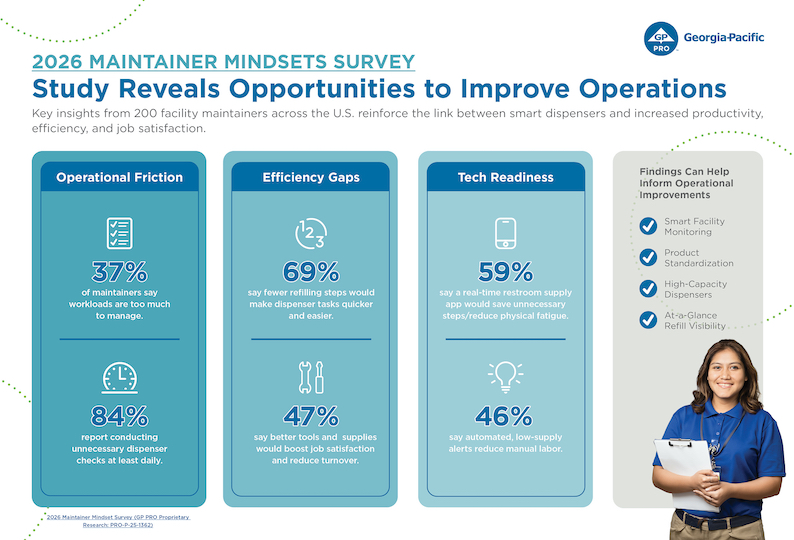 GP Pro, a division of Georgia-Pacific and a leading innovator in advanced dispensing and smart monitoring solutions, has this week announced the findings of its Annual Maintainer Mindset Survey, an ongoing benchmark study that evaluates the mindsets, work habits and operational realities of commercial facilities maintenance workers.
Building on foundational research reported last year, the 2026 Maintainer Mindset Survey identified operational friction that strains workloads and job satisfaction, as well as the growing importance of smart dispensers designed to boost productivity, efficiency and job satisfaction.
GP PRO's 2026 Maintainer Mindset Survey reveals where maintenance teams lose time and efficiency, and how smart dispensers help close the gap.
"The findings of this year's Maintainer Mindset Survey continue to dispel long-held misconceptions, including the belief that maintainers are a transient, tech-averse workforce," says the company's Michelle Auda, senior director, insights and knowledge.
"Our research reveals that these hard-working professionals see themselves as critical operational partners who are eager to embrace new tools that not only help make their jobs easier but also empower them to better support the people and facilities they care for."
Of those polled, 81% expect to remain in their jobs long term, with 49% planning to stay at the same level, and 32% seeing a pathway into management. Time in the role aligns with age, with 62% to 65% of participants over 35 reporting more than a decade of tenure.
Job satisfaction also correlates with age: 83% of 45- to 54-year-olds report being "very satisfied," while only 23% of 18- to 24-year-olds share that sentiment.
Nearly half of all participants (47%), however, cite better tools and supplies as key to improving job satisfaction and reducing turnover, ranking them as important as adequate staffing.
Reducing operational friction is a priority
The Survey also highlights growing operational friction, exacerbated by increasing foot traffic, labour shortages and unsustainable workloads. The survey reveals that 37% of maintainers describe their daily workload as either "too much" or "entirely too much" to manage. Routine, manual processes compound this burden and consume valuable time. An overwhelming 84% of maintainers report conducting unnecessary dispenser checks at least daily-walking into public washrooms to manually inspect paper towel, bath tissue, and soap dispensers only to find them completely or adequately full.
When asked which inventory and refilling tasks they wish were easier and faster, maintainers cited the following: checking dispenser supply levels (40%), refilling soap and hand sanitiser dispensers (36%), refilling paper towel dispensers (29%), and refilling bath tissue dispensers (26%). Unproductive checks across large-scale facilities create unnecessary physical fatigue and take time from deep-cleaning tasks.
Debunking myths: high demand for smart, connected tools
Contrary to long-standing assumptions that frontline cleaning workers resist digital adoption, the 2026 survey reveals a workforce actively seeking smart technology to bring order and predictability to their shifts. Nearly six in 10 maintainers (58%) feel happy, and nearly half (48%) feel excited about using new facility equipment.
Among those polled, 59% of maintainers expect a real-time supply application to cut unnecessary footsteps, reduce physical fatigue, and help them stay ahead of patron complaints. While pay remains the top reason for switching employers, access to better tools and equipment is the second most important criterion.
Making the case for intuitive, simplified product design
In an industry marked by labour constraints, the Survey shows a direct link between equipment design, worker satisfaction and employee retention. An overwhelming 78% of respondents report that simplified restocking tasks directly boost their job satisfaction-up 17 percentage points from last year's survey (61%).
When asked which specific design features would make dispenser maintenance quicker and simpler, maintainers emphasised intuitive features that minimise manual labour: fewer steps in the refilling process (69%), at-a-glance visibility to evaluate supply levels without opening covers (54%), and smart dispensers equipped with automated, low-supply alerts (46%).
Complete survey findings are available at:
29th October 2026