 Cleanzine: your weekly cleaning and hygiene industry newsletter 15th October 2026 Issue no. 1230
Your industry news - first
The original and best - for over 20 years!
We strongly recommend viewing Cleanzine full size in your web browser. Click our masthead above to visit our website version.


Ergonomics risk assessment tools market to reach $3.4 billion by 2033
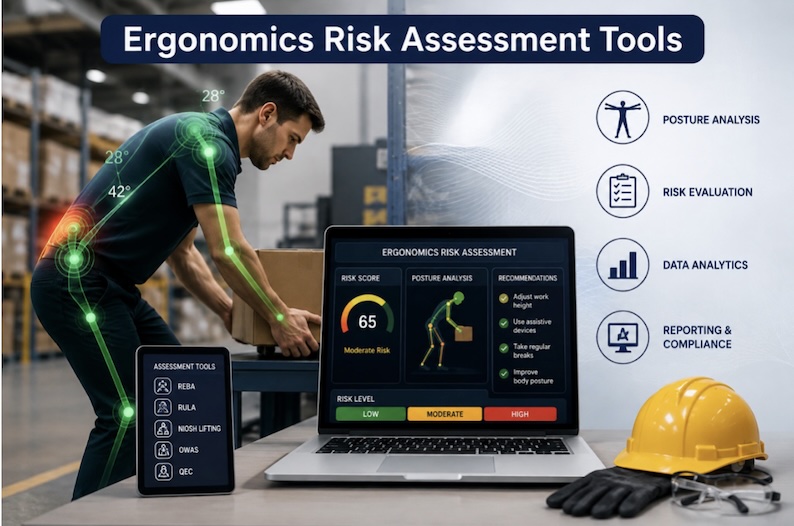 According to Research intelo, the Global Ergonomics Risk Assessment Tools market size was valued at $1.2 billion in 2024 and is projected to reach $3.4 billion by 2033, expanding at a robust CAGR of 12.6% during the forecast period of 2025–2033.
One of the primary factors fueling the expansion of this market is the increasing corporate emphasis on workplace health and safety, driven by stringent regulations and the rising incidence of work-related musculoskeletal disorders (MSDs).
Organisations across various sectors are proactively integrating ergonomics risk assessment tools to mitigate occupational hazards, enhance workforce productivity, and reduce compensation costs associated with workplace injuries. The growing adoption of advanced software and hardware solutions, coupled with the proliferation of cloud-based deployment models, is further propelling the growth trajectory of the ergonomics risk assessment tools market on a global scale.
Introduction
The Ergonomics Risk Assessment Tools Market is evolving as organizations worldwide place greater emphasis on preventing work-related musculoskeletal disorders, improving employee wellbeing, and designing safer workplaces. Ergonomic assessment is no longer limited to paper-based checklists or occasional consultant evaluations. Modern organizations increasingly combine established assessment methodologies with digital platforms, mobile applications, video analysis, sensors, and artificial intelligence.
At its core, an ergonomics risk assessment tool helps organizations identify physical factors that may contribute to discomfort, fatigue, strain, or musculoskeletal disorders. These factors can include awkward postures, repetitive movements, excessive force, manual handling, vibration, prolonged sitting, and poorly designed workstations. The National Institute for Occupational Safety and Health (NIOSH) provides several assessment approaches, including the Revised NIOSH Lifting Equation, Rapid Entire Body Assessment (REBA), Rapid Upper Limb Assessment (RULA), and other methods.
The market is therefore moving from simple risk identification toward continuous, data-driven ergonomics management.
What Are Ergonomics Risk Assessment Tools?
Ergonomics risk assessment tools are methodologies, software applications, calculators, questionnaires, sensors, and digital systems used to evaluate how workplace activities affect the human body. They help safety professionals determine whether a particular task presents low, moderate, or significant ergonomic risk and identify opportunities for corrective action.
Different tools are designed for different workplace scenarios. RULA, for example, concentrates strongly on upper-limb, neck, and trunk postures, while REBA provides a broader whole-body assessment. The Revised NIOSH Lifting Equation is designed to evaluate risks associated with two-handed manual lifting and lowering tasks.
This specialization is important because there is no single assessment method capable of accurately describing every ergonomic hazard. Research reviewing workplace hazard-identification methods has identified numerous validated tools covering physical, psychosocial, and comprehensive risks.
Why Is the Ergonomics Risk Assessment Tools Market Growing?
The central growth factor is the increasing recognition that workplace ergonomics is a productivity issue as well as a safety issue. Poorly designed tasks can contribute to fatigue, discomfort, reduced efficiency, absenteeism, and musculoskeletal disorders. Companies therefore have an economic incentive to identify ergonomic risks before they develop into costly workplace problems.
Manufacturing plants, warehouses, healthcare facilities, construction sites, logistics operations, offices, laboratories, and service businesses all contain different forms of ergonomic exposure. A warehouse worker may repeatedly lift and carry packages, while an office employee may remain seated and perform repetitive keyboard and mouse movements. Both environments require ergonomic evaluation, but the appropriate assessment methodology can be very different.
Another important factor is the increasing availability of digital assessment platforms. Instead of completing forms manually, safety professionals can increasingly capture task information through mobile devices, attach photographs or videos, automatically calculate scores, and store assessment histories. Emerging platforms are also applying computer vision and AI-based posture analysis to ergonomic evaluations.
Key Assessment Tools Shaping the Market
Rapid Upper Limb Assessment (RULA)
RULA is widely associated with evaluating upper-body ergonomic exposure. It considers factors involving areas such as the arms, wrists, neck, and trunk. It can be particularly useful when assessing workstation activities, assembly operations, repetitive upper-limb movements, and tasks requiring sustained or awkward upper-body positions.
Its value comes from converting observations into a structured risk score that can help organizations determine whether further investigation or workplace modification is appropriate. NIOSH lists RULA among established tools for evaluating upper-body ergonomic risks.
Rapid Entire Body Assessment (REBA)
REBA extends the assessment perspective across the body. It considers the neck, trunk, legs, arms, and wrists and can be useful for tasks involving varied or unpredictable postures.
This makes REBA relevant to industries such as healthcare, manufacturing, construction, warehousing, and material handling, where employees may frequently change body positions. NIOSH describes REBA as an observational approach capable of classifying tasks across multiple levels of risk.
Revised NIOSH Lifting Equation
Manual lifting remains a major area of ergonomic concern. The Revised NIOSH Lifting Equation helps employers evaluate two-handed lifting and lowering tasks using quantitative information about the task. NIOSH states that the equation can support safer task design, ergonomic risk assessment, worker awareness, and research.
Its application makes it particularly relevant to logistics, manufacturing, warehousing, distribution, and other sectors where workers regularly handle physical loads.
Quick Exposure Check and Other Methods
Quick Exposure Check (QEC), Strain Index methods, Rodgers Muscle Fatigue Assessment, vibration assessments, and other specialized approaches expand the range of ergonomic conditions that organizations can evaluate. NIOSH's resource library demonstrates that ergonomic risk assessment encompasses multiple body regions and exposure types rather than a single universal measurement.
From Paper Checklists to Intelligent Platforms
One of the most important changes in this market is the transition from static assessment forms to connected digital platforms.
Traditional ergonomic assessments often require an assessor to observe a worker, record measurements, complete calculations, and prepare a report. Digital platforms can streamline several of these steps. They can store assessments centrally, calculate risk scores automatically, attach photographic or video evidence, and enable organizations to compare results across departments or locations.
The next stage involves computer vision. AI-enabled systems can analyze images or video to estimate body positions and joint angles before applying recognized assessment frameworks. Emerging commercial platforms already advertise video-based analysis using methods such as RULA, REBA, and the NIOSH lifting equation.
However, automation should complement—not blindly replace—professional judgment. Ergonomic assessment involves task context, exposure duration, force, repetition, individual variation, work organization, and environmental conditions. A numerical score is valuable only when it is interpreted correctly.
How AI Is Changing Ergonomic Risk Assessment
Artificial intelligence could become one of the most transformative technologies in the ergonomics risk assessment tools market.
Computer vision can potentially identify posture patterns from workplace videos without requiring workers to wear sensors. AI systems can estimate joint positions, detect repeated movements, identify potentially awkward postures, and organize large volumes of observations.
The biggest advantage is scalability. A human ergonomist may be able to conduct detailed assessments for selected high-priority tasks, but organizations operating hundreds of workstations across multiple facilities need more scalable methods.
AI-assisted systems can potentially create a continuous assessment cycle: capture a task, identify risk, calculate an assessment score, recommend an intervention, and reassess the task after changes are implemented.
This could shift ergonomics from an occasional compliance activity into a continuous improvement process.
Major End-User Industries
Manufacturing
Manufacturing is one of the most significant application environments because workers may perform repetitive assembly, lifting, reaching, pushing, pulling, and precision activities. Ergonomic tools help identify high-risk workstations and support workstation redesign.
Healthcare
Healthcare workers frequently perform patient handling, transferring, bending, reaching, and prolonged standing. Whole-body assessment approaches can help identify physically demanding activities and guide safer task design.
Warehousing and Logistics
The expansion of e-commerce and modern distribution networks has increased attention toward manual material handling. Workers may repeatedly lift packages, move goods, push carts, or perform picking operations. Quantitative lifting and whole-body assessment tools can help identify opportunities for intervention.
Construction
Construction environments are dynamic and involve lifting, carrying, kneeling, climbing, awkward positioning, and tool handling. Because working conditions can change rapidly, flexible assessment methods are particularly valuable.
Offices and Knowledge Work
Ergonomics is not limited to industrial workplaces. Computer-based work can involve prolonged sitting, repetitive hand movements, poorly positioned monitors, and static postures. Digital workstation assessment platforms can help organizations evaluate these risks across distributed office environments.
Market Segmentation
The Ergonomics Risk Assessment Tools Market can be analyzed across several dimensions.
By tool type, the market includes observational assessment tools, lifting calculators, questionnaires, software platforms, wearable systems, sensor-based solutions, video-analysis systems, and AI-powered assessment platforms.
By application, major categories include manual handling, repetitive motion, workstation assessment, posture evaluation, lifting and carrying, vibration exposure, fatigue assessment, and whole-body ergonomic evaluation.
By end user, the market encompasses manufacturing companies, healthcare organizations, logistics providers, construction companies, offices, government institutions, occupational health professionals, and ergonomics consultants.
By deployment, solutions can be categorized into desktop software, mobile applications, cloud-based platforms, on-premise systems, and increasingly AI-enabled computer-vision solutions.
What Are the Main Challenges?
Despite its potential, the market faces several challenges. The first is tool selection. Different tools measure different risk factors, and choosing the wrong method can produce misleading conclusions.
The second challenge is data quality. AI and video-based assessments depend on adequate camera positioning, visibility, movement capture, and contextual information. A system that accurately identifies posture may still struggle to understand the complete physical demands of a task.
The third challenge is implementation. An assessment has limited value if an organization does not act on its findings. Ergonomic improvements may require workstation redesign, equipment investment, workflow changes, employee training, or changes in task rotation.
Another challenge is standardization. A systematic review found gaps in the availability of comprehensive tools capable of supporting all stages of workplace risk management.
What Are the Opportunities for Market Participants?
The strongest opportunity lies in combining validated ergonomic methodologies with user-friendly technology.
Software companies can develop platforms that allow professionals to select an appropriate assessment method, conduct evaluations from mobile devices, maintain photographic evidence, automate scoring, schedule reassessments, and visualize risk trends.
There is also considerable opportunity in AI-assisted assessment. Rather than replacing professional ergonomists, technology can reduce repetitive administrative work and help experts prioritize the tasks requiring deeper investigation.
Another opportunity is integration. Ergonomic risk data can potentially be connected with occupational health systems, safety management platforms, workforce analytics, training systems, and enterprise dashboards. This would allow ergonomics to become part of broader operational decision-making.
The Future of the Ergonomics Risk Assessment Tools Market
According to Research intelo, Automation will reduce manual calculations and repetitive documentation. Accessibility will allow smaller organizations and non-specialist teams to perform structured preliminary assessments. Intelligence will help organizations identify patterns across large amounts of workplace data.
The most valuable platforms will not simply produce a risk score. They will help answer a more important question: What should the organization do next?
This distinction could become a major competitive factor. A platform that identifies a high-risk posture but provides no meaningful pathway for intervention has limited practical value. A platform that identifies the risk, explains its contributing factors, recommends potential interventions, tracks implementation, and measures the result can become a strategic workplace-safety system.
https://researchintelo.com/report/ergonomics-risk-assessment-tools-market
3rd September 2026